

Introduction
Running a business today is not easy. Owners and managers handle many tasks at the same time, including customer support, sales, marketing, accounting, and daily operations. Doing everything manually takes time, increases costs, and often leads to mistakes. This is where AI tools for business automation make a real difference. These tools help businesses work smarter instead of harder.
AI Tools For Business Automation use intelligent systems to perform repetitive tasks automatically. They help companies save time, improve accuracy, and focus on growth. From sending emails to managing customer data and tracking performance, automation is now accessible to both small and large businesses.
Many beginners think automation is only for big companies with large budgets. In reality, affordable and easy-to-use tools are now available for startups, freelancers, and growing businesses. Even basic automation can reduce workload and improve productivity.
What is AI Tools for Business Automation?
AI tools for business automation are software solutions that use artificial intelligence to perform business tasks automatically. These tools learn from data, follow rules, and make smart decisions without constant human input.
Business automation focuses on reducing manual work. When combined with AI, automation becomes more powerful and flexible. It can handle tasks like responding to customer messages, analyzing sales data, scheduling meetings, and managing inventory.
For example, an AI-powered chatbot can answer customer questions 24/7. An automated accounting tool can track expenses and generate reports. These tools work quietly in the background while teams focus on more important work.
AI tools for business automation are designed to be user-friendly. Most platforms offer simple dashboards, drag-and-drop features, and clear instructions. You do not need technical skills to get started. This makes automation practical for almost every business type and size.
Why is AI Tools for Business Automation Important?
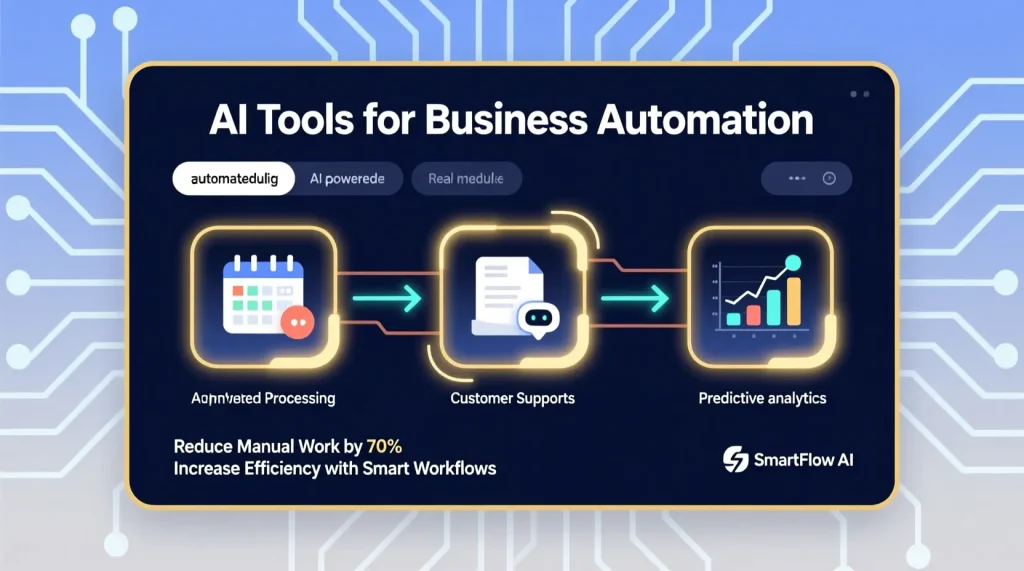
Automation is no longer optional in modern business. Companies that rely only on manual work often struggle to keep up with competitors. AI tools for business automation provide a strong advantage by improving speed, accuracy, and efficiency.
One major reason automation is important is time savings. Repetitive tasks like data entry or email follow-ups can take hours every week. Automation completes them in seconds. This allows teams to focus on strategy, creativity, and customer relationships.
Another key reason is consistency. Automated systems follow the same rules every time. This reduces errors and improves service quality. Customers receive faster responses and better experiences.
Cost reduction is also important. Automation lowers labor costs and reduces waste. Businesses can grow without hiring large teams. As markets become more competitive, automation helps companies stay efficient and profitable.
Detailed Step-by-Step Guide
Step 1: Identify Tasks to Automate
Start by listing daily tasks that consume time. Look for repetitive and rule-based activities. Examples include email replies, invoice generation, and social media posting.
Choose tasks that do not require creative thinking. These are the best candidates for automation.
Step 2: Set Clear Business Goals
Define what you want to achieve with automation. Goals may include saving time, improving customer service, or increasing sales accuracy.
Clear goals help you choose the right AI tools for business automation and measure success later.
Step 3: Choose the Right AI Tools
Research tools that match your needs. Focus on ease of use, pricing, and customer support. Many tools offer free trials, which are helpful for testing.
Avoid complex platforms at the start. Simple tools deliver faster results and are easier to manage.
Step 4: Prepare Your Data
AI systems work best with clean and organized data. Remove duplicates, fix errors, and structure information properly.
Good data quality improves automation accuracy and performance.
Step 5: Start Small and Test
Begin with one process. Test the automation carefully before expanding. Monitor results and fix issues early.
Testing helps prevent mistakes and builds confidence in the system.
Step 6: Train Your Team
Explain how automation works and how it supports daily tasks. Encourage team members to share feedback.
Training ensures smooth adoption and reduces resistance to change.
Step 7: Monitor and Improve
Track performance regularly. Look for areas to improve or expand automation.
Automation is not a one-time setup. Continuous improvement delivers better results over time.
Benefits of AI Tools for Business Automation
- Saves time by handling repetitive tasks automatically
- Reduces human errors and improves accuracy
- Lowers operational costs
- Improves customer response time
- Increases productivity and efficiency
- Supports better decision-making through data insights
- Scales easily as the business grows
Disadvantages / Risks
- Initial setup can take time
- Poor data can lead to incorrect results
- Over-automation may reduce human interaction
- Dependence on technology may cause issues during system failures
- Some tools require regular updates and monitoring
Common Mistakes to Avoid
Many businesses rush into automation without planning. One common mistake is trying to automate everything at once. This often leads to confusion and poor results.
Another mistake is ignoring data quality. AI tools for business automation depend on accurate information. Poor data creates errors and weak performance.
Choosing tools without proper research is also risky. Not every tool fits every business. Always test before committing.
Finally, failing to involve employees causes resistance. Automation should support people, not replace communication and teamwork.
FAQs
What types of businesses can use AI tools for business automation?
Almost any business can benefit. Small shops, online stores, service providers, and large companies all use automation. The key is choosing tools that match business size and goals.
Are AI tools for business automation expensive?
Many tools are affordable and offer flexible pricing. Some platforms provide free plans or trials. Costs usually depend on features and usage.
Do I need technical skills to use automation tools?
Most modern tools are beginner-friendly. They offer simple interfaces and guides. Basic computer knowledge is usually enough.
Can automation replace employees?
Automation supports employees rather than replacing them. It removes repetitive work so teams can focus on creative and strategic tasks.
How long does it take to see results?
Simple automation can show results within days. Larger systems may take weeks to fully optimize. Consistent monitoring speeds up success.
Is business data safe with automation tools?
Most reputable tools follow strong security standards. Always review privacy policies and choose trusted platforms.
Expert Tips & Bonus Points
Start with high-impact tasks that save the most time. This creates quick wins and builds confidence.
Document your automation processes. Clear documentation helps with training and troubleshooting.
Review automation performance monthly. Small adjustments can improve efficiency significantly.
Combine human judgment with automation. Balanced systems deliver better customer experiences.
Stay updated on new features. AI tools for business automation improve constantly, and updates often add valuable functions.
Conclusion
AI tools for business automation are transforming how companies operate. They help businesses save time, reduce costs, and improve efficiency without increasing workload. For beginners, automation may seem complex at first, but starting small makes the journey manageable and rewarding.
By automating repetitive tasks, businesses can focus on growth, creativity, and customer satisfaction. The key is understanding your needs, choosing the right tools, and improving processes step by step. Automation is not about removing people from work. It is about giving teams the freedom to do better work.
As competition increases, businesses that adopt AI tools for business automation gain a strong advantage. They respond faster, make smarter decisions, and scale more easily. With careful planning and continuous improvement, automation becomes a long-term asset.